What Is Air Permeability?
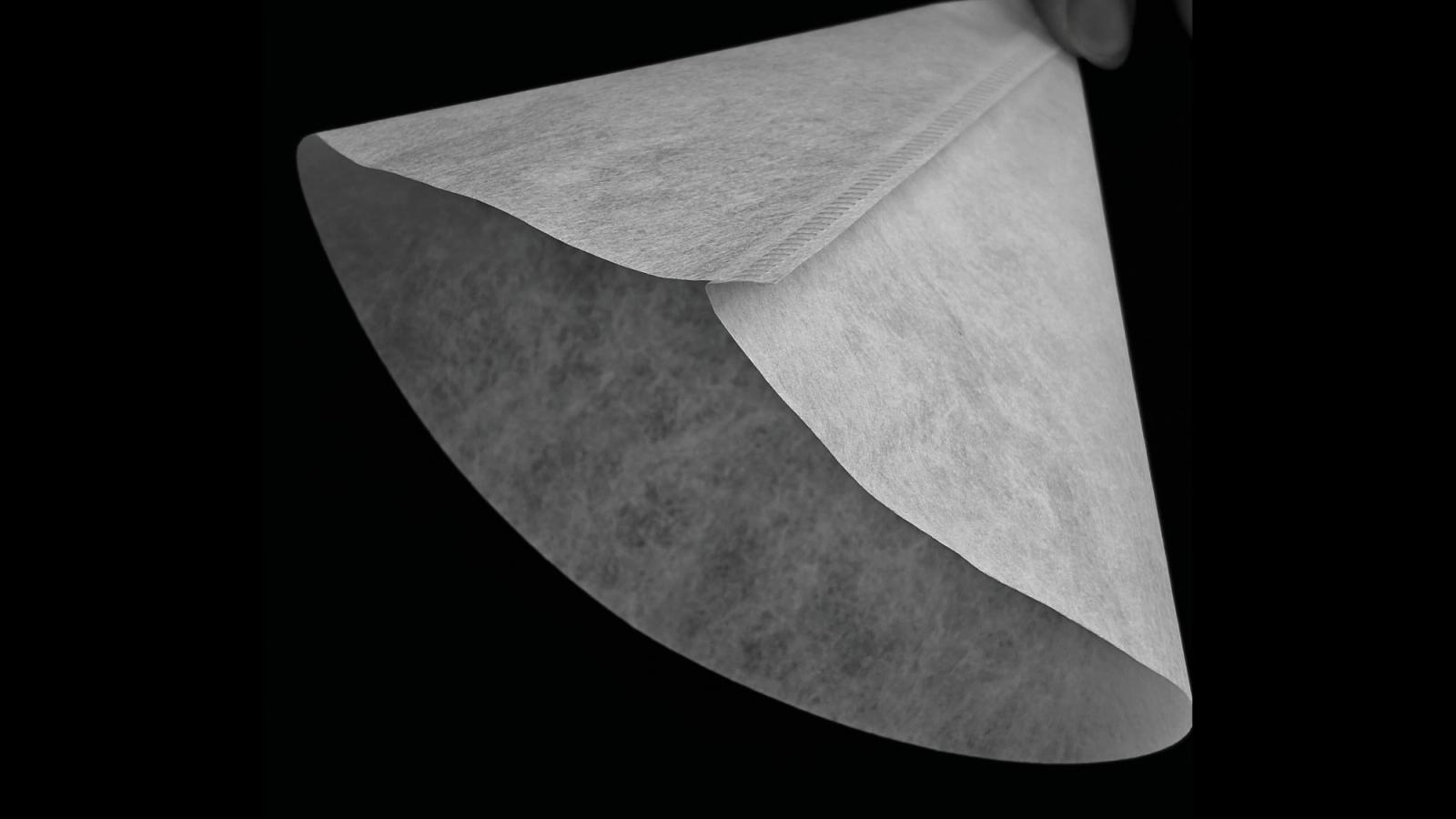
Coffee filter paper is made from a network of fibers. Between these fibers are microscopic spaces that form pathways through the sheet.
Air permeability measures how easily air can move through these pathways under defined test conditions. A paper with a more open structure generally allows air to pass through more easily, while a denser structure creates greater resistance.
It is important to note that air permeability is not exactly the same as porosity.
Porosity describes the amount of open space within a material, while air permeability describes how easily air actually moves through that structure. Two papers may have similar porosity but different pore sizes and pore structures, resulting in different air permeability and flow behavior.
Why Does It Matter for Coffee Brewing?
In coffee filtration, water needs to move through the coffee bed and then through the filter paper.
The filter paper adds resistance to this flow. Its fiber structure, density, thickness, pore structure, and permeability all contribute to how quickly the liquid drains. This means changing the paper can change the overall brewing time—even when the coffee, grinder, and brewer remain the same.
A filter with a more open structure may allow faster drainage. A denser structure can provide greater resistance and slow the flow.
But higher air permeability does not automatically mean better coffee.
Fast flow may reduce contact time, while excessively slow flow can create unnecessary retention in the filter. The goal is not simply to maximize permeability. The goal is to develop a paper structure that provides the right balance between flow rate and particle retention for the intended application.
Air Permeability and Filter Performance
For coffee filter paper manufacturers, air permeability can be useful as part of quality control and product development.
A consistent permeability value can help indicate whether the fiber structure and forming process are stable from batch to batch. However, it should not be evaluated alone.
Other properties also matter, including:
- Basis weight and thickness
- Fiber type and fiber distribution
- Pore structure
- Particle retention
- Wet strength
- Liquid flow rate
In other words, a filter paper is not defined by one number.
Two papers may have similar air permeability but still produce different results because their fiber structure, thickness, or particle-retention characteristics are different.
How Do You Choose the Right Air Permeability?
There is no single “best” air permeability for every coffee filter.
A V60 filter, basket filter, drip bag, or commercial coffee filtration application may require different performance characteristics. The right specification depends on the target flow rate, coffee particle size, brewing method, filter size, and desired cup profile.
For B2B buyers, the more useful question is not:
“What is the highest air permeability?”
It is:
“What air permeability and paper structure give us the flow and filtration performance we need?”
That is where laboratory testing and real brewing tests become important. A datasheet can provide a starting point, but the final evaluation should be made under the actual brewing conditions and equipment used by the customer.
The Bottom Line
Air permeability may not be something you can see when you look at a sheet of coffee filter paper, but it can have a real impact on how that paper performs.
It helps us understand the internal structure of the paper and its resistance to air—and, indirectly, provides useful insight into liquid flow and filtration behavior.
For coffee filter paper, the best performance is rarely about simply making the paper more or less permeable.
It is about finding the right balance between permeability, flow rate, and particle retention—and keeping that balance consistent from one filter to the next.
Because in coffee filtration, consistency is what turns a good filter into a reliable one.